
Who's Responsible For This?

Conspiracy theories aren't new, but they’re certainly having a moment. For the past decade, it’s become difficult—if not impossible—to spend even a few minutes on your favorite social media app without encountering totally normal people making outlandish claims about hidden actors manipulating events behind the scenes or coordinated efforts by elites to conceal the truth from ordinary citizens. Gone are the days when these theories were confined to the margins, circulating only among tiny groups of dedicated believers in their parents’ basements. Now we’re seeing them everywhere, mainstreamed by elected officials and media personalities, with millions of people latching on to them who once would have immediately laughed away such obviously implausible or offensive ideas.
For a lot of people, the sharp rise in online conspiratorial thinking at the same time that AI usage is booming appears to signal a new inability to distinguish between fantasy and reality. If conspiracy theories are flourishing and everyone is turning to AI to determine what’s true, perhaps people have simply stopped using their brains (as we’ve been warned is a consequence of AI usage). Perhaps, as the meme goes, the internet was a mistake: we’ve destroyed our attention spans and undermined our critical faculties to such an extent that we’re basically incapable of looking at the world around us and seeing reality.
I don’t want to say this is wrong and I certainly don’t want to downplay the way that our newfound reliance on AI is making us much, much dumber. But this explanation for why we’re all so conspiracy-curious is probably too easy and too self-congratulatory. It definitely feels good to people like me, who have largely dumped social media and who have an allergic reaction to AI, and it also allows people who haven’t fallen for any conspiracy theories (yet!) to see themselves as uniquely rational actors living among people who recently lost their minds. While you’re certainly free to pay these compliments to yourself, I have the feeling that people have always been vulnerable to conspiratorial thinking and that we’re just seeing more of it because we’re more closely connected than we have been at any other time.
It’s not news that people have gone in for conspiratorial explanations whenever they’ve been faced with uncertainty and instability. There’s something hardwired in us that points us to easy answers for complex questions, especially if those answers identify clear villains and make it clear that anything that’s gone wrong wasn’t our fault. Whether it’s centuries-old antisemitic myths about Jews poisoning wells or controlling global affairs, or those pesky witches who curse their communities with diseases, or hordes of Communists secretly infiltrating Western governments during the Cold War, imagining unseen enemies is something we’ve always been good at doing. Psychologists who study this stuff will tell you that people want to understand the world around them, they want to feel that they are in control of their lives, and they want to belong to communities that affirm who they are and what they believe. And, of course, conspiracy theories neatly satisfy all of these desires.
At a very basic level, we’re meaning-making creatures. We don’t like randomness and we’re not even all that happy with more than a little bit of ambiguity. We prefer tidy explanations and we don’t like the idea that things don’t necessarily happen for a reason. When confronted with events that have complicated causes or that go against our preferences, we naturally seek out the stories that can connect causes and effects in ways that work best for us. And that’s all fine, except that sometimes the most psychologically satisfying explanations for what’s going on aren’t the ones that are actually consistent with reality.
In this sense, conspiracy theories function as mechanisms for restoring order when we’re confronted by experiences that feel chaotic. They provide narratives in which nothing is accidental and apparent coincidences are revealed to be clues pointing toward a hidden truth. Even frightening explanations can feel preferable to uncertainty because they imply that someone is in control. And it’s much, much better when that someone is to blame and we couldn’t possibly have known that the choices we were making were the wrong ones.
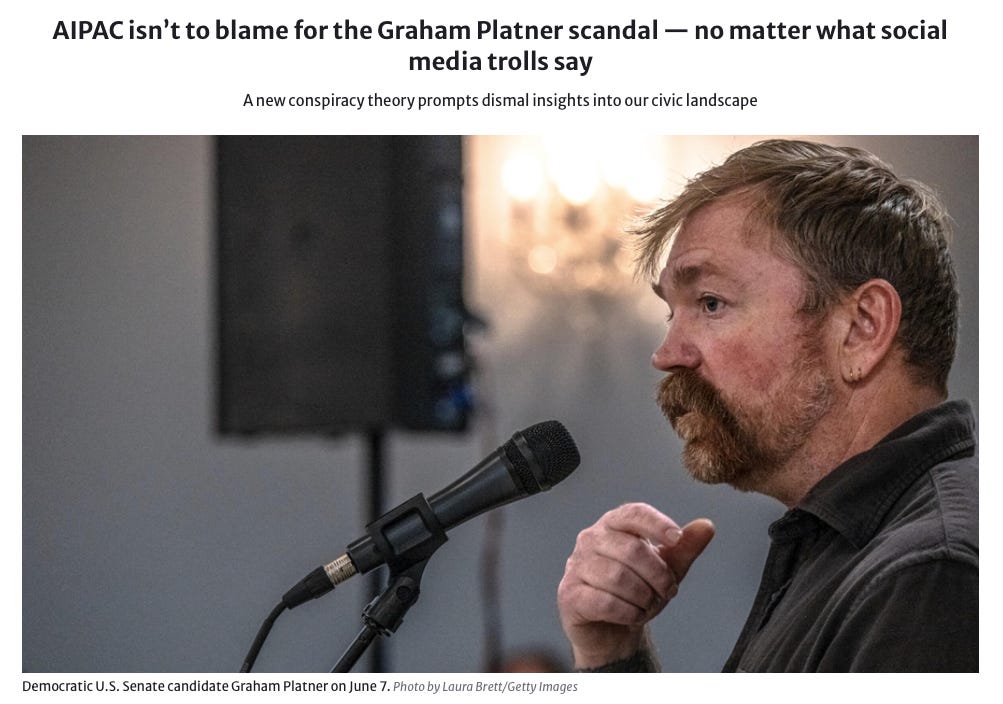
Take the recent implosion of Graham Platner’s Senate campaign and the way in which some of his most ardent supporters—or some of the most ardent opponents of Susan Collins—desperately sought out explanations that suited them better than the simple notion that he was a really bad candidate because of serious problems in his personal life. In the hours before Platner finally announced the suspension of his candidacy, people turned to conspiracy theories to try make sense of what happened. “The timing of this allegation is certainly extremely suspicious.” “Who is paying these women to make these allegations?” And my personal favorite: “AIPAC is behind all of this.” All of that is much easier to say to oneself than “I backed the wrong guy” or “I should have drawn the line much earlier, probably at the news of his Nazi tattoo or at the very least at the first round of allegations by women.”
This tendency is perfectly rational, even if it kind of looks extremely irrational on the surface. One way to think about it is as a kind of pattern recognition that’s gotten fouled up by a lot of false positives. Recognizing patterns simplifies a lot of tasks for us and, crucially, it allowed our evolutionarily successful ancestors to anticipate danger and locate resources in an environment where it meant the difference between life and death. On the savannah, it would be much safer to assume that any movement in the grass signals the presence of a predator rather than to dismiss it as something harmless. Over time, though, this assumption can encourage people to think that they’re seeing meaningful connections where none actually exist. Conspiracy theories exploit precisely this inclination by encouraging believers to view incomplete information as proof that things are being concealed from them.
Seen in this light, conspiracy theories might better be thought of as attempts to satisfy a need for understanding and control, rather than a failure of logic and reason. That recognition should probably make us more sympathetic and less dismissive of people who fall into this trap, especially since those of us who avoid a conspiracy theory today might find ourselves falling for one in the future. It’s obviously extremely tempting to imagine that this is a problem for the gullible or uneducated, but in truth we all prefer certainty to ambiguity and meaning to chaos, and we’re all good at finding the patterns that help us navigate daily life.
In that case, I’d offer that we have two challenges to tackle.
The first is to offer some measure of grace to people who we might call conspiracy-minded. There is a lot of anxiety out there at the moment, whether it’s due to political instability, democratic backsliding, climate change, geopolitical conflict, economic insecurity, the erosion of norms, or any number of other possible sources of perceived threat. Conspiracy theories provide emotionally satisfying answers because they identify responsible parties (who aren’t us) and and simplify our complicated reality into an easy-to-understand story. If we can recognize that a lot of people are living with pretty reasonable fears, we might find ways to talk to them that help to (re)establish the trust that is essential to combat conspiratorial thinking. People who trust scientists and the process of scientific research are less likely to believe that modern science amounts to a campaign of coordinated deception. People who trust the democratic process and election officials are less likely to believe that elections are being manipulated by secret actors. People who trust journalists are less likely to believe that any reporting with which they disagree is fake or propaganda. And most importantly, people who know and trust one another are less likely to be manipulated by influencers and conspiracy entrepreneurs.
The second challenge is learning to live with uncertainty. This is no simple task for us because it’s basically a demand to accept that social problems have multiple causes rather than single villains and that many important events emerge from complicated systems rather than from the intentional schemes of nefarious actors. As much as it makes us uncomfortable, there’s a real benefit in acknowledging the contingency and disorder of the world and of our lives. Things didn’t necessarily have to end up this way and things don’t necessarily have to continue to this. That willingness to to ask questions whose answers might not be immediately forthcoming and to reject the certainty that arises from grand narratives and hidden enemies is one of the most important capacities we can develop in a moment that’s increasingly defined by suspicion and fear.
On the idea of "trusting journalists", this reminds me of Newspeak's goal to abolish wrongthink. Journalists have been probably lying to Americans for at least the last several years. There shouldn't be a reason to trust journalists. Simply ensure they provide sources and check the original sources yourself. Many will discover the original sources don't line up with what is being reported.